What parents should know
Autism is not a disease. It is a developmental condition that affects how a child communicates, connects with others, and behaves. Some children may also show repetitive habits or very strong interest in certain routines or objects.
The most important thing for parents to remember is this: if you notice early signs, do not ignore them. Getting help early can make a big difference. Children can start support sooner, and this can help with speech, learning, behavior, and daily life. Research also shows that early identification and early intervention can improve outcomes for many children.
What is autism?
Autism, also called autism spectrum disorder, can affect a child in different ways.
Social interaction
A child may not connect with people in the usual way.
Communication
This may include delayed speech, not responding to name, less pointing, poor eye contact, or difficulty using gestures.
Behavior and interests
Some children may repeat the same actions, become upset by small changes, or focus strongly on certain objects or routines.
Why early recognition matters
Many parents feel that something is different even before anyone gives a diagnosis. That feeling should not be ignored.
Autism can often be recognized quite early, sometimes around 2 to 2.5 years of age. When support starts early, children may do better because the young brain learns and adapts more easily. Children who are identified late may have more difficulties with speech, learning, sleep, behavior, anxiety, or sensory issues.
Early signs parents should watch for
1. Not responding to name
Most babies begin responding to their name around 8 to 9 months, and by the first birthday this is usually expected. If a child does not respond to name, it should not be ignored. It may be linked to hearing problems, developmental delay, or autism.
2. Poor eye contact
A child may avoid looking at people or look away often during interaction.
3. Not pointing to show interest
Pointing is an important milestone. By around 14 to 15 months, many children point to show what they want or what they find interesting. If a child never points and instead only pulls an adult toward things, this should be taken seriously.
4. Leading by hand instead of communicating
Some children take a parent’s hand and place it on an object instead of pointing, showing, or asking.
5. Loss of words or social skills
This is a very important sign. If a child was speaking, interacting, or playing normally and then suddenly stops, parents should not wait. Loss of already learned skills needs proper evaluation.
6. Repetitive behaviors or strong routines
Examples include:
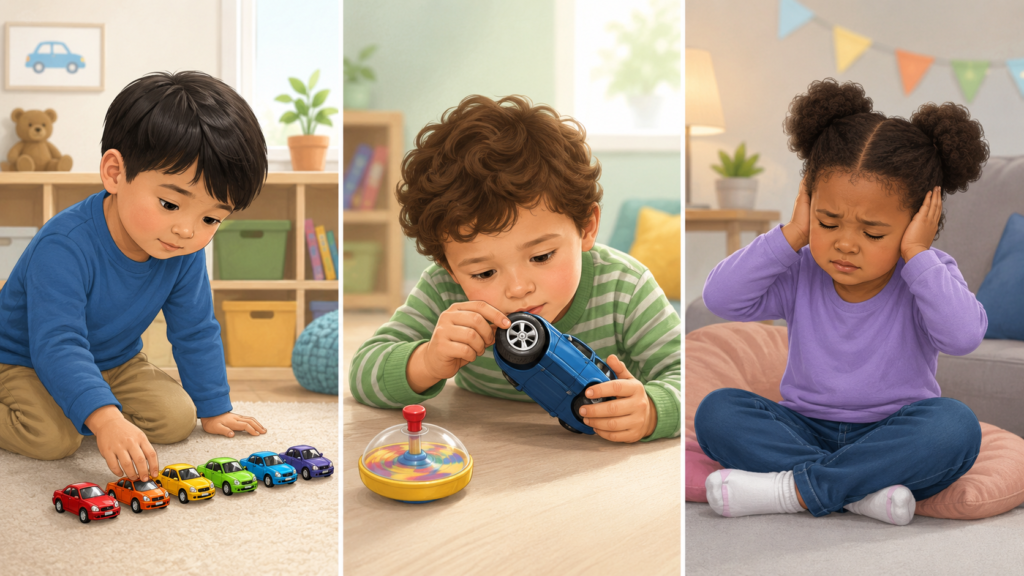
- lining up toys
- spinning wheels of toy cars
- insisting on the same routine every day
- becoming very upset by small changes
- strong attachment to certain objects or patterns
7. Preferring to be alone most of the time
Some children may not show much interest in playing with others, copying actions, or sharing attention.
When should parents be concerned?
Every child may sometimes ignore a name, play alone, or repeat certain actions. What matters is the pattern.
Parents should seek professional advice sooner if a child shows more than one of these signs:
- poor response to name
- poor eye contact
- delayed speech
- no pointing
- loss of skills
- repetitive behaviors
- little interest in interaction
If these signs continue over time, it is better to get the child checked rather than wait too long.
What should parents do if they suspect autism?
1. Do not ignore your concern
Sometimes people may say, “He will talk later,” or “Don’t worry.” But if you notice clear delays or loss of skills, it is okay to ask for help.
2. Meet the right specialist
A developmental pediatrician or child development specialist can assess your child’s speech, behavior, communication, and social development, and guide you on the next steps.
3. Get hearing tested if advised
If a child does not respond when called, hearing should be checked. Hearing problems and autism can sometimes look similar at first, so hearing testing is important.
4. Start help early
Parents do not always need to wait for a final label before starting developmental support. If clear concerns are present, early help is often more useful than waiting.
Do vaccines cause autism?
No. Vaccines do not cause autism.
This is a common myth, but large scientific studies have not found any causal link between childhood vaccines and autism. Delaying or avoiding vaccines can put children at real risk from serious illnesses that can be prevented.
Can autism happen in a younger sibling too?
If one child has autism, the chance is slightly higher in younger brothers or sisters compared with the general population. But this does not mean the next child will definitely have autism.
It simply means parents should watch development carefully and act early if they notice signs.
Can a child have autism even if they can speak?
Yes. Some children with autism can speak in sentences and still have difficulties with social communication, eye contact, understanding others, or flexible behavior.
So speaking alone does not rule out autism.
Here is the next part of your blog in simple, parent-friendly language.
What Other Health or Daily-Life Problems Can Happen Along With Autism?
Autism does not affect every child in the same way. Along with communication and social difficulties, some children may also have other health or behavior-related problems.
These can include:
- stomach problems like constipation, diarrhea, or tummy pain
- reflux or frequent discomfort after eating
- sleep problems
- restricted eating or being very selective with food
- pica, which means eating things that are not food
- anxiety or mood changes
- seizures in some children
- food allergies in some cases
Not every child will have these problems, but parents should watch for them. Sometimes these issues affect the child’s behavior, sleep, and daily routine. For example, a child who is constipated, anxious, or not sleeping well may seem more irritable or restless.
It helps to keep a small note of what you notice, such as eating problems, sleep changes, stomach complaints, or unusual behaviors, and discuss them with your child’s doctor. Looking after these everyday health concerns can make a big difference in the child’s comfort and progress.
Can Autism Be Cured With Medicines?
This is a very common question for parents. The simple answer is no medicine cures autism itself.
Autism is not an illness that can be removed with one tablet or syrup. Medicines do not change the basic features of autism, such as social communication differences or repetitive behaviors. However, in some children, medicines may be used to help with related problems like:
- severe hyperactivity
- anxiety
- aggression
- sleep difficulties
- other associated conditions
This is why parents need to be careful about false promises. If someone says they can “completely cure” autism with medicines, powders, or special products, that should be viewed with caution. Good care usually focuses on helping the child learn, communicate better, manage daily life, and feel more comfortable — not chasing miracle cures.
What Kinds of Therapies Can Help?
There is no single therapy that works the same way for every child. The right support depends on the child’s strengths, difficulties, age, and daily needs.
Speech and language therapy
This can help children understand language better, communicate their needs, and improve speech or nonverbal communication.
Occupational therapy
This may help with daily activities, sensory challenges, play skills, attention, and independence.
Behavioral and developmental approaches
Some children may benefit from structured teaching or developmental programs that focus on communication, behavior, learning, play, and social skills.
The most important thing is not the name of the therapy alone. What matters is whether the therapy is helping your child in real life — for example, speaking better, understanding more, playing more meaningfully, coping better, or becoming less distressed.
What Can Parents Do at Home?
Parents play one of the biggest roles in helping a child with autism. Progress does not happen only in therapy sessions. It also happens at home, during everyday life.
Home support does not have to mean turning the house into a classroom. It means helping your child learn naturally during daily routines.
Helpful things parents can do
- speak simply and clearly
- join the child in play instead of only giving instructions
- encourage communication during meals, dressing, bathing, and play
- notice what makes the child anxious or upset
- reduce situations that feel too noisy, too bright, or too overwhelming
- work step by step, not all at once
- praise small efforts and small improvements
One important thing to remember is that children should not be pushed harshly into behaviors they find very stressful. For example, forcing eye contact again and again may increase anxiety instead of helping. The goal is to support the child gently, patiently, and in ways that build trust.
What About Hyperactivity, Anxiety, or Sensory Problems?
Many children with autism may also seem very active, easily upset, anxious, or sensitive to sounds, touch, lights, smells, or changes in routine.
Sometimes a child looks “naughty” or “difficult,” but the real reason may be something else:
- the child may not understand what is expected
- the environment may feel overwhelming
- the task may be too hard
- the child may be anxious, uncomfortable, or frustrated
In simple words, behavior is often a sign that the child is struggling, not that the child is “bad.”
Parents can help by asking:
- What happened just before this behavior?
- Was the room too noisy or crowded?
- Was the child confused or frustrated?
- Was the demand too difficult?
Once the trigger is understood, it becomes easier to reduce stress and support the child better. Research on parents’ experiences also shows that reducing sensory overload and understanding anxiety triggers can be very helpful for autistic children.
How Can Parents Judge Whether Therapy Is Helping?
This is a very important question. Parents should feel comfortable asking clear questions about therapy.
A good therapy plan should explain:
- what the child is working on
- what goals are expected
- how progress will be checked
- what changes parents should watch for over time
For example, instead of only saying “your child is improving,” it is more helpful if the therapy team can explain specific progress such as:
- now responds to name more often
- uses more words or gestures
- tolerates daily routine better
- shows less frustration
- plays more purposefully
If a therapy center cannot explain what it is doing, what change is expected, or how progress is being measured, parents have the right to ask more questions.
A Realistic Message for Parents
Hearing that a child may have autism can feel overwhelming. Many parents go through fear, sadness, confusion, guilt, or denial at first. These feelings are normal.
But there are a few things parents should hold on to:
Do not lose time
If you have concerns, get help early.
Do not lose hope
Many children make meaningful progress with the right support.
Do not believe myths
Autism is not caused by poor parenting, and vaccines do not cause autism.
Do not wait for everything to be perfect
You do not need to have every answer before starting support. Small steps matter.
Parents do not need to be perfect. What children need most is understanding, patience, the right guidance, and a supportive environment.
Conclusion
If your child is not responding to name, not pointing, avoiding eye contact, losing words, or showing repetitive behaviors along with communication and social difficulties, it is a good idea to seek help early.
Waiting too long can delay support that may truly help. The best approach is simple:
notice early, get the child assessed, start support early, and stay involved.
Children with autism need understanding, structure, skilled support, and patient families. They do not need blame, shame, or misinformation.