
A Simple Parent’s Guide to Children’s Sleep and Physical Activity

Introduction
Many parents ask the same questions every day: Is my child sleeping enough? How much screen time is too much? Does my child need more physical activity? Can poor sleep affect mood, learning, and behavior? The answer is yes—these daily habits play a very important role in a child’s overall health and development.
Sleep helps the body grow, supports brain development, improves mood, and helps children stay active and alert during the day. Physical activity keeps the heart, bones, muscles, and mind healthy. On the other hand, too little sleep, too much screen time, and long hours of sitting can affect concentration, school performance, emotional balance, and even physical health over time.
According to the Indian Academy of Pediatrics, sleep, physical activity, and reduced sedentary time must work together to support a child’s well-being. Children who sleep well and move more usually have better energy, better focus, and healthier daily routines.
This guide is written in simple language to help parents understand what healthy sleep and physical activity really look like at different ages, why they matter, and what practical steps can be taken at home to build better habits for children.
Why sleep is so important for children
Sleep is not just “rest time.” It is an active process during which the body and brain do important work. According to the IAP guideline, sleep helps conserve energy, restore body processes, support physical growth and development, improve mood, and help children function well during the day.
What happens during sleep?
There are two main stages of sleep:
REM sleep
This is the stage linked with dreaming and brain activity.
Non-REM sleep
This includes deeper sleep, when the body gets important recovery time.
These stages keep changing through the night in cycles. Good-quality sleep allows the brain and body to move through these cycles properly.
How much sleep does a child need?
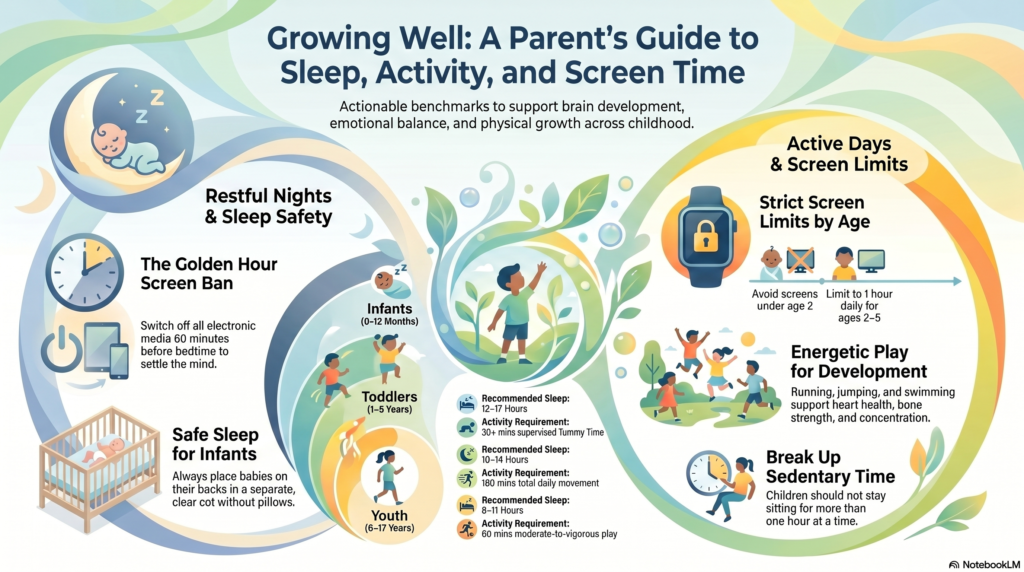
Sleep needs change with age. The recommended sleep ranges are :
0–3 months: 14–17 hours
4–11 months: 12–15 hours
1–2 years: 11–14 hours
3–5 years: 10–13 hours
6–13 years: 9–11 hours
14–17 years: 8–10 hours
These are general ranges, so a child may be slightly above or below and still be normal. But if sleep is regularly too short, parents should pay attention.
What Happens When a Child Does Not Sleep Enough?
Sleep loss affects more than tiredness
When a child does not get enough sleep, the effects are seen far beyond bedtime. Poor sleep can influence how a child feels, behaves, learns, and functions through the day. It is not just about being sleepy. Lack of sleep can slowly affect both physical health and emotional well-being.
Common signs parents may notice
Children who are not sleeping enough may show:
- daytime sleepiness
- irritability and mood swings
- behavior problems
- trouble paying attention
- learning difficulties
- poor school performance
- higher risk of accidents in older children and teenagers
These signs are often mistaken for laziness, stubbornness, or lack of interest, when the real problem may be insufficient sleep.
How sleep affects health and development
Healthy sleep supports brain function, emotional control, memory, and body growth. Research also shows that children who sleep well tend to have better mental health, better concentration, and stronger learning outcomes. Good sleep is also linked with a lower risk of overweight and obesity. Studies on 24-hour movement habits show that children do best when they combine enough sleep, regular physical activity, and less sedentary time.
Why parents should pay attention
If poor sleep becomes a daily pattern, it can affect a child’s confidence, routine, and long-term health. Protecting sleep is one of the simplest ways parents can support a child’s growth and development.
Simple Tips to Help Children Sleep Better
The good news is that better sleep usually starts with small, steady changes at home. Children sleep best when bedtime feels predictable, calm, and safe.
1. Keep bedtime and wake-up time regular
A child’s body loves routine. When sleep and wake times stay nearly the same every day, the body clock works better and sleep comes more naturally. Even on weekends or holidays, try not to shift the schedule too much.
2. Switch off screens before bed
Phones, tablets, TV, and video games can keep the brain alert when it should be slowing down. Try making the last hour before bedtime a screen-free hour. This gives the mind time to settle.
3. Create a bedtime ritual
Children sleep better when bedtime follows the same peaceful pattern each night. A warm bath, brushing teeth, a bedtime story, soft conversation, dim lights, or a cuddle can all signal that sleep time is near.
4. Avoid late-night sugar and caffeine
Chocolate drinks, cola, tea, coffee, and energy drinks can disturb sleep. In the evening, lighter and calming options work better.
5. Make the bedroom sleep-friendly
A quiet, comfortable, slightly dim room helps children relax. Keep the sleeping space free from noise, bright lights, and digital distractions.
The secret is not perfection. It is consistency. Small bedtime habits, repeated every night, can make a big difference.
Safe Sleep for Babies
Why safe sleep matters
In the first year of life, sleep safety is just as important as sleep duration. A baby may spend most of the day sleeping, so the sleep environment needs to be as safe as possible. Safe sleep habits can lower the risk of sudden unexpected sleep-related problems in infancy.
Simple safe sleep rules every parent should follow
A few basic habits can make a big difference:
Always place your baby on the back to sleep
Back sleeping is the safest sleep position for healthy babies.
Use a separate sleep space
Your baby should sleep in a separate cot or crib with a firm, flat surface.
Keep the bed simple
Use a firm mattress with a tight-fitting sheet. Avoid pillows, soft cushions, stuffed toys, blankets, and loose bedding.
Share the room, not the bed
Keeping the baby’s cot in the parents’ room is helpful, but bed-sharing is not advised.
Keep the head and face uncovered
Nothing should block your baby’s breathing during sleep.
Avoid smoke exposure
Smoking around babies increases risk and should be strictly avoided.
Breastfeeding offers extra protection
Breastfeeding is another step that supports safer infant sleep.
These may sound like small details, but together they create a much safer sleep environment.
Common Sleep Problems Parents Notice
When bedtime becomes a battle
Many parents notice that their child does not simply lie down and sleep. Some children resist bedtime, wake up repeatedly, or keep calling for a parent again and again. These patterns are common, but if they continue for too long, they can turn into exhausting habits for the whole family.
Sleep-onset association
Some children learn to fall asleep only in a very specific way. They may need a parent beside them, the TV on, rocking, or another comfort object every time they fall asleep. The problem comes later in the night. When they wake naturally, they cannot settle again unless the same condition is recreated.
Limit-setting problems
Other children delay bedtime with repeated requests such as:
- “I want water”
- “I need the toilet”
- “I’m scared”
- “Stay with me”
These bedtime delays are sometimes called “curtain calls.” They are common, but they can become a long-term pattern if there are no calm boundaries.
Gentle Strategies That Really Help
1. The checking method
Settle your child, leave the room, and return after a short time to reassure them. Then gradually increase the gap between visits. This helps the child learn to fall asleep without needing constant presence.
2. The camping-out method
Sit near your child at bedtime for a few nights, then slowly move farther away over several days. This gives comfort while also building independence.
3. Set clear bedtime limits
Children should not be allowed endless bedtime negotiations. A calm, loving, and consistent response works better than anger or giving in every night.
The real secret: calm consistency
Sleep problems rarely improve overnight. But when parents stay patient, predictable, and firm, bedtime usually becomes smoother with time.
Should Parents Worry About Night Terrors, Nightmares, or Sleepwalking?
When nights feel scary for parents
Few things are more unsettling than seeing your child suddenly scream, talk, cry, or walk around in the middle of the night. The good news is that many of these sleep events are common in childhood and, in most cases, temporary. They often look more frightening than they really are.
Night terrors
Night terrors usually happen in the first part of the night. A child may sit up, scream, sweat, or look terrified, but is often still asleep and usually does not remember the episode the next morning. For parents, this can be alarming, but many children outgrow it with time.
Nightmares
Nightmares are different. They usually happen later in the night during dream sleep. The child wakes up properly, may cry or feel scared, and often remembers the dream. Gentle reassurance, a calm voice, and a sense of safety usually help.
Sleepwalking
Sleepwalking happens during deep sleep. A child may get out of bed, walk with eyes open, and seem awake, but is not fully aware. The most important thing here is safety. Lock doors, clear sharp objects, and gently guide the child back to bed.
Sleep talking
Sleep talking is very common and often harmless. It usually settles on its own, especially when overall sleep improves.
When to seek help
Most children outgrow these problems. But if episodes happen very often, lead to injury risk, disturb the whole family regularly, or seem unusual, it is a good idea to talk to a pediatrician.
What Is Sedentary Behavior?
More than just “resting”
Sedentary behavior means spending a lot of time sitting or lying down while awake and using very little energy. In modern childhood, this often means long hours spent with:
- TV
- mobile phones
- tablets
- computers
- video games
Not all quiet time is harmful. Reading, storytelling, drawing, and puzzles are calm activities that can support learning and development. The bigger concern is long stretches of passive screen-based sitting.
Why too much sitting matters
When children sit too much, they move less, burn less energy, often sleep worse, and miss out on the physical and mental benefits of active play. Too much sedentary time has been linked with poorer health, weaker sleep habits, and lower academic performance.
How Much Sedentary Time Is Okay?
Simple screen and sitting limits by age
Healthy limits help children balance rest, play, and movement.
Below 2 years
Electronic media should be avoided.
2 to 5 years
Entertainment screen time, such as TV or tablets, should stay under 1 hour a day.
Under 5 years
Children should not remain sedentary for more than 1 hour at a time unless they are asleep.
5 to 17 years
Sedentary time should be kept as low as possible, and entertainment screen use should ideally stay within 2 hours a day.
A helpful way to think about it
The goal is not to remove all quiet time. The goal is to break up long sitting periods and make movement a normal part of the day.
Why Physical Activity Matters So Much
Movement builds more than muscles
Physical activity is not only about sports, fitness classes, or weight control. It supports a child’s whole development — body, brain, mood, confidence, and sleep.
Regular activity helps children build:
- a healthy heart and lungs
- strong bones, muscles, and joints
- better coordination and muscle control
- a healthy body weight
- better posture, balance, and flexibility
- improved concentration and thinking
- better sleep
- stronger emotional and social well-being
Long-term health benefits
Children who stay active are also less likely to develop health problems such as obesity, high blood pressure, and type 2 diabetes later on.
What research shows
Research consistently supports this. Children who move more, sit less, and sleep well tend to have better cardiometabolic health, better mental health, and often stronger school performance. In simple words, active children usually feel better, function better, and grow better.
How Much Activity Does a Child Need at Each Age?
Children do not need the same type or amount of activity at every age. As they grow, their bodies, muscles, coordination, and play style change too. The good news is that exercise for children does not have to mean formal workouts. For most children, movement should feel like play, fun, and part of everyday life.
Birth to 1 year
Even babies need active time. At this age, supervised tummy time while awake is very important. Aim for at least 30 minutes spread through the day. This helps build neck strength, shoulder control, and early motor skills. Simple movements such as reaching, grasping, rolling, crawling, and moving the head, body, and limbs all count as healthy activity.
1 to 2 years
Toddlers should be active for at least 3 hours across the day. This does not need to happen all at once. Walking around, climbing safely, dancing, pushing toys, and active free play all help build strength, balance, and coordination.
3 to 5 years
Preschool children also need about 3 hours of activity every day, and at least 60 minutes of it should be energetic play. Running, jumping, dancing, climbing, ball games, and swimming are great options. At this stage, movement supports both body and brain development.
5 to 18 years
Older children and teenagers should be active every day, with at least 1 hour of moderate-intensity activity. They should also do muscle- and bone-strengthening activities at least 3 days a week. Cycling, walking, football, dance, gymnastics, basketball, skipping, running, tennis, and playground games are all excellent choices.
The best kind of activity
The best activity is usually the one a child enjoys enough to do regularly. A child who loves dancing, cycling, swimming, or outdoor games is far more likely to stay active than one forced into an activity they dislike.
What About Children With Autism, Cerebral Palsy, ADHD, or Diabetes?
Every child deserves the chance to move, play, and enjoy activity. Children with developmental conditions or chronic illnesses should not be left out. They may need adjustments, extra encouragement, or activities suited to their abilities, but movement is still important for their health and confidence.
Autism spectrum disorder
Children with autism often do best when activity matches their interests. When parents notice what the child enjoys and build around that, exercise becomes easier and more enjoyable. The goal is not only fitness, but also fun, routine, and confidence.
ADHD
Physical activity can be especially helpful for children with ADHD. Active play and structured movement may improve concentration, timing, balance, and self-control. Activities such as yoga, martial arts, dance, climbing, and gymnastics can be useful because they combine movement with focus.
Cerebral palsy
For children with cerebral palsy, the aim is to reduce long periods of sitting and encourage whatever movement is possible. This may include adaptive bikes, swimming, hydrotherapy, wheelchair sports, or supported standing. Even small increases in activity can improve strength, function, and mood.
Diabetes
Exercise helps the body use insulin better and supports healthier blood sugar control. Children with diabetes should absolutely be encouraged to stay active, but parents may need to plan meals, snacks, or insulin changes with medical guidance when needed.
The most important message
Inclusion matters. Children should be encouraged to move and participate according to their ability, not compared with others. The aim is progress, enjoyment, and a healthy routine.
A Simple Daily Routine Parents Can Aim For
Parents do not need a perfect timetable to raise healthy children. What helps most is a simple daily pattern that supports sleep, movement, and calm family routines.
A healthy day often includes
A regular bedtime and wake-up time helps the body settle into a natural rhythm. Minimal screens before bed make it easier for the brain to relax. Outdoor play, walking, cycling, or active games help children stay strong and sleep better at night. Long hours of sitting should be broken up with movement. A calm, safe sleep space also matters. Most importantly, children do best when the whole family supports healthy habits consistently.
When movement becomes part of normal family life rather than a special task, it is much easier to maintain.
Conclusion
Sleep, screen time, and physical activity are closely connected. A child who sleeps well is usually better able to learn, manage emotions, and stay active through the day. A child who moves, plays, climbs, runs, and explores every day usually sleeps better and feels better. A child who spends long hours sitting with screens often misses many of these benefits.
Parents do not need expensive toys, gym memberships, or strict routines to build healthy habits. What children need most is a stable daily rhythm, enough sleep, regular movement, less sitting, and a home environment that makes these habits easier.
In the end, healthy childhood is built through ordinary daily choices. A little more play, a little less screen time, and a little more consistency can make a big difference over time.