Introduction
As parents, we all want our children to eat well, grow well, and stay healthy. But in real life, feeding children is not always easy. Busy schedules, school pressure, food advertising, picky eating, and the easy availability of packaged snacks make it hard to choose healthy food every day.
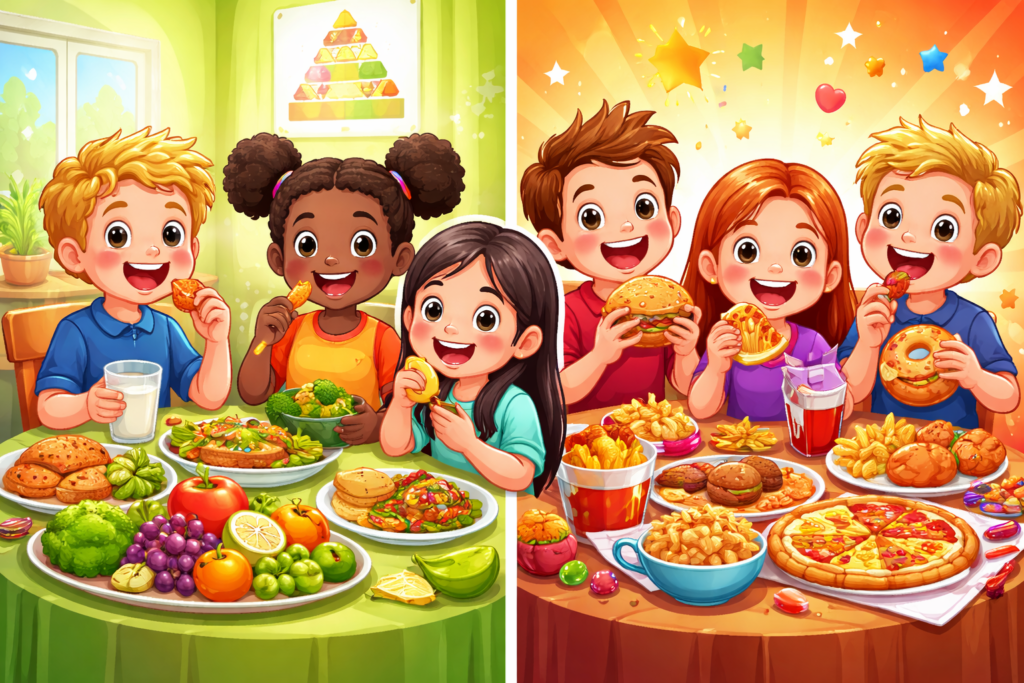
Many parents ask the same questions:
Is bread or cornflakes healthy?
Can I give juice every day?
Are homemade pizza and burgers okay?
What should I do if my child refuses home food?
The good news is that healthy eating does not need to be confusing. With the right information, small daily choices can make a big difference.
What is junk food?
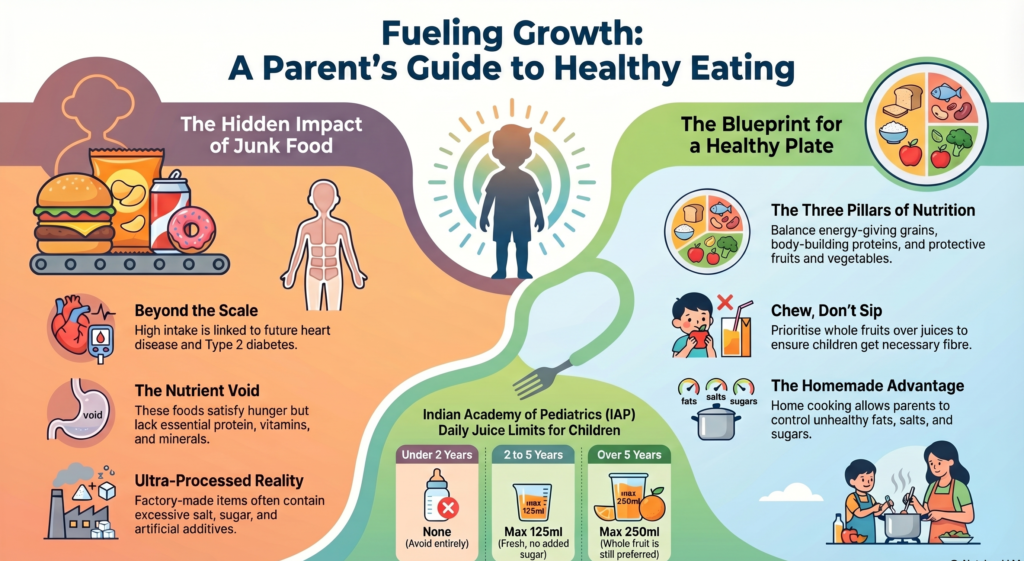
Junk food is food that gives a lot of calories but very little real nutrition. It is usually high in:
Sugar
Salt
Unhealthy fats
Artificial colors, flavors, and additives
Many of these foods are also called ultra-processed foods. These are foods made mostly in factories using many ingredients, preservatives, flavor enhancers, and added sugar or salt.
Common examples of junk food
- Packaged chips and snacks
- Instant noodles
- Burgers, fries, pizza, and many fast foods
- Sugary breakfast cereals
- Soft drinks and energy drinks
- Packaged juices and flavored drinks
- Ice creams and many ready-made desserts
- Milk supplement powders with high added sugar
The Indian Academy of Pediatrics groups these foods and drinks under unhealthy categories and advises that children should avoid them as far as possible. If given at all, intake should be very limited.
Why junk food is harmful for children
Many parents think junk food is only a “weight problem.” But the harm is much bigger than that.
1. It fills the stomach but not the body
Junk food may satisfy hunger for a short time, but it usually lacks enough protein, fiber, vitamins, and minerals. This means a child may eat plenty of calories and still miss important nutrients needed for growth.
2. It can lead to weight gain and obesity
Systematic reviews show that unhealthy foods and sugar-sweetened beverages in childhood are linked with a higher risk of overweight, obesity, and cardiometabolic problems later on. Children who often eat ultra-processed foods tend to consume more calories and poorer-quality diets overall.
3. It increases the risk of future disease
Frequent intake of highly processed foods, sugary drinks, and excess salt is associated with a greater long-term risk of:
Type 2 diabetes
High blood pressure
Heart disease
Abnormal cholesterol levels
The IAP guideline also explains that continued intake over time can disturb the body’s lipid profile and increase the risk of diabetes, heart disease, and high blood pressure.
4. It damages teeth
There is strong evidence that frequent intake of sugary drinks and ultra-processed foods increases the risk of dental caries in children. This is especially true when sweet drinks are sipped often during the day.
5. It can affect sleep and behavior
Caffeinated drinks such as tea, coffee, cola, and energy drinks can increase heart rate and may disturb sleep, attention, and mood. In children and teenagers, too much caffeine can cause restlessness, anxiety, tremors, and poor sleep. The IAP guideline clearly says energy drinks should not be given to children and adolescents.
Why packaged foods are not always as healthy as they look
Modern food packaging is designed to look healthy. Words like “fortified,” “energy,” “multigrain,” “immunity,” and “real fruit” can confuse parents.
Breakfast cereals
Many packaged cereals may be low in fat but high in refined sugar. The IAP parent guideline points out that products such as cornflakes often contain sugar, flavoring, and corn syrup, making them less healthy than many parents assume.
Bread
Bread is easy and convenient, but it should not replace balanced meals. White bread is high in refined carbohydrates and low in fiber and protein. Even many “brown breads” are not truly whole grain.
Milk supplement powders
Many marketed milk powders for children contain significant added sugar. The IAP guidance notes that these are ultra-processed products and are usually unnecessary for healthy children who are eating a normal balanced diet.
Packaged juices
These are often seen as healthy, but many contain added sugar and very little fiber. Whole fruit is a much better choice.
What healthy eating really looks like for children
Healthy eating for children does not have to be expensive, complicated, or trendy. In most families, the healthiest meals are often the simplest ones made at home. A good child’s diet is built around fresh, familiar foods that give energy, support growth, and help build strong bones, teeth, muscles, and immunity. The aim is not to make every meal perfect. The aim is to make everyday food simple, balanced, and mostly home-cooked.
Children do best when meals are based on regular family foods such as cereals, dals, vegetables, fruits, milk or curd, and other protein-rich foods. The Indian Academy of Pediatrics also advises that children’s meals should be low in added sugar, low in salt, low in saturated fat, and based mainly on natural, minimally processed foods.
Healthy options for babies, toddlers, and young children
For babies up to 6 months
For the first six months, exclusive breastfeeding is recommended. This means the baby should receive only breast milk unless a doctor advises otherwise. The IAP guideline clearly says that babies in this age group should not be given ghutti, honey, water, tea, juices, or top milk. Breast milk provides the nutrition and fluids a baby needs in the early months and also supports immunity and healthy growth.
After 6 months
After six months, babies need complementary foods along with continued breastfeeding. This is the stage when soft, homemade foods can be introduced slowly and patiently. Good first foods are simple, soft, and easy to digest. Examples include khichdi, dalia, mashed banana, mashed potato, boiled and mashed vegetables, curd, upma, and mashed idli. These foods are suitable because they are gentle on the stomach and can be made fresh at home without excess salt, sugar, or spices.
At this stage, parents should focus on variety. A child should slowly get used to different textures and tastes. This helps prevent fussiness later and builds healthier food habits from the beginning.
For toddlers and older children
As children grow, their meals should become more balanced and filling. Everyday healthy meals do not need to be fancy. Common homemade foods can provide everything a growing child needs. Good options include dal and rice, chapati with vegetables, curd, egg, fruit, poha, upma, idli, dosa, chilla, beans, and home-cooked chicken or fish.
These foods give a mix of carbohydrates for energy, protein for growth, vitamins and minerals for immunity, and fiber for digestion. A simple plate with dal, rice or chapati, one vegetable, and curd is often far healthier than packaged snacks or ready-to-eat foods.
What a healthy child’s plate should look like
A healthy diet for children should include:
- energy-giving foods like rice, roti, poha, idli, or dalia
- body-building foods like dal, egg, curd, beans, chicken, or fish
- protective foods like fruits and vegetables
This balance matters more than expensive health foods or marketed “children’s foods.”
A simple rule for parents
The best meals for children are usually:
- fresh
- homemade
- varied
- low in sugar and salt
- rich in natural foods
In simple words, healthy eating for children means giving regular home food, avoiding too many packaged foods, and building habits that children can follow for life.
Should children drink juice?
This is one of the most common questions parents ask.
Whole fruit is better than juice
Whole fruit contains fiber, takes longer to eat, and is more filling. Juice, even homemade juice, removes much of the fiber and can make children consume a lot of sugar very quickly.
According to the IAP parent guidance:
Children under 2 years
Fruit juice should not be offered.
Children 2 to 5 years
If given, only a small amount of fresh homemade juice without added sugar should be offered, up to about 125 mL per day.
Children older than 5 years
Up to about 250 mL per day may be given, but whole fruit is still the better choice.
Best drink for children
Plain clean water remains the best drink for most children.
Are homemade burgers, pizza, halwa, poori, or samosa still junk food?
This is where many parents get confused.
Homemade is better, but not always healthy
Making food at home is usually better than buying processed versions because home food has:
Less preservative
Less artificial color
Better hygiene control
More control over salt, sugar, and oil
But homemade foods like pizza, burger, halwa, poori, sewaiyaan, samosa, or fried snacks can still become unhealthy if they are made with:
Too much oil
Refined flour
Too much sugar
Repeatedly heated oil
Too much butter or cream
The IAP guideline suggests making these foods healthier by:
Using less sugar and salt
Avoiding reused oil
Using whole wheat instead of maida where possible
Choosing jaggery sometimes instead of refined sugar
Avoiding preservatives and colors
So the answer is simple: homemade is better, but balance still matters.
Which oil should parents use?
No single oil is perfect. The IAP guidance suggests changing oils from time to time, such as using groundnut, mustard, or soybean oil in rotation. Olive oil may also be used depending on the dish.
What matters most
Do not reuse oil again and again for frying
Repeated reheating increases unhealthy trans fats, which are harmful for the heart and overall health.
Can children have ghee or butter?
Yes, in small amounts. They can be part of a healthy diet, but not in excess. Saturated fat should remain limited.
What to do when a child refuses home food
This is a daily struggle in many families, and shouting usually makes it worse.
The IAP parent guideline gives very practical advice.
Helpful strategies for parents
Stay calm
Do not turn every meal into a battle.
Do not force-feed
Force feeding can increase food refusal.
Keep junk food out of the house
Children cannot demand what they do not see every day.
Be a role model
Children copy adults. If parents drink cola and eat chips often, children will do the same.
Introduce one healthy food at a time
Small steps work better than sudden big changes.
Improve taste and presentation
Cut fruit in fun shapes, add color, or serve small portions attractively.
Avoid constant snacking
If a child is always snacking, real hunger never comes.
Involve children in meal preparation
Children are more likely to eat food they helped make.
Can children drink tea, coffee, or energy drinks?
Parents often allow tea or coffee during exams or late-night study. But this can backfire.
The IAP guideline states:
Children below 5 years
No caffeinated or carbonated drinks should be given.
School-age children and adolescents
Tea and coffee should be very limited. The guideline mentions only small amounts, and only if no other caffeine sources are being taken.
Energy drinks
These are a strict no for children and adolescents.
Too much caffeine can cause:
Fast heartbeat
Sleep problems
Restlessness
Anxiety
Poor concentration
Mood changes
Children need sleep, routine, and balanced meals far more than stimulants.
Simple daily food rules parents can follow
Healthy eating becomes easier when parents follow a few practical rules.
Make most meals home-based
Simple home food is usually the healthiest option.
Offer fruit, not juice
Children should chew fruit, not drink most of it.
Keep sugary drinks for “never or almost never”
Soft drinks, energy drinks, and packaged juices should not be daily items.
Read labels
Choose products with less sugar, less salt, and fewer ingredients.
Do not use food as reward
Avoid saying, “If you finish dinner, I will give chocolate.”
Plan snacks
Healthy snacks can include:
Fruit
Curd
Roasted chana
Boiled corn
Peanuts if age-appropriate
Homemade sandwiches
Idli or poha
Egg
Make children sit and eat
Eating while watching screens often leads to overeating and poor food choices.
A realistic message for parents
Parents do not need to be perfect. Children do not need a “clean diet” every single day. What matters most is the overall pattern.
A healthy pattern means
- Fresh food most of the time
- Junk food only rarely
- Water instead of sugary drinks
- Whole fruit instead of packaged juice
- Family meals when possible
- Calm, steady feeding habits
Small changes repeated every day work better than strict rules followed for only one week.
Conclusion
Junk food is not just an occasional treat problem. When it becomes a habit, it can affect a child’s weight, teeth, sleep, heart health, and long-term eating patterns. The strongest message from both child health guidance and research is simple: the more natural, balanced, and home-based the diet, the better it is for children.
Parents do not need expensive superfoods. They need clear information, regular routines, and confidence in simple home meals. A plate of dal, rice, vegetables, curd, fruit, and water may look ordinary, but for a growing child, it is powerful nutrition.