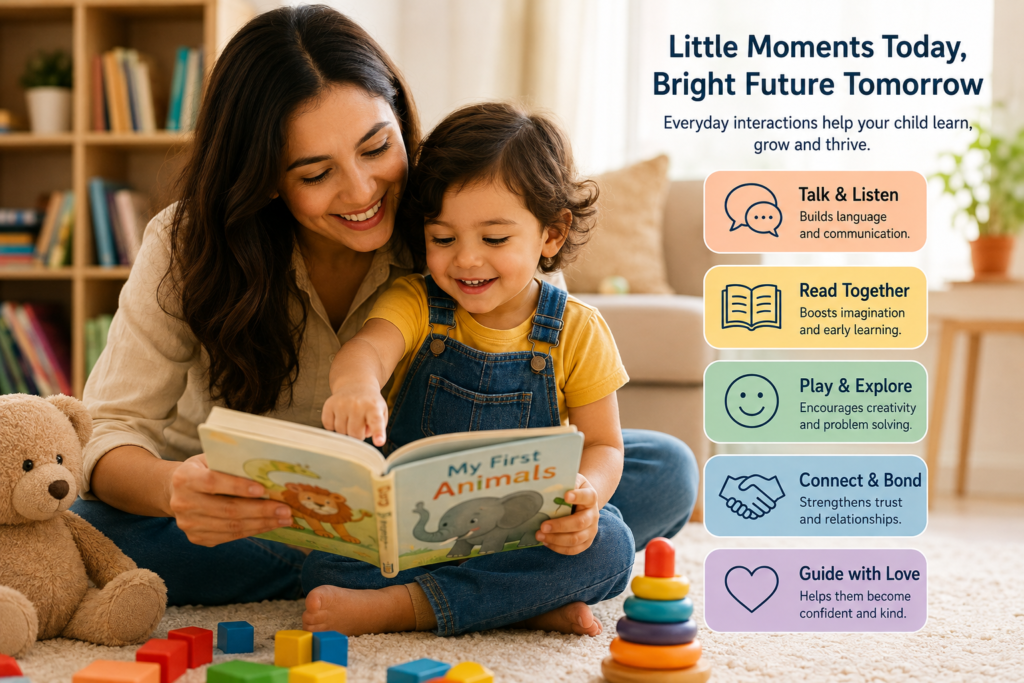
The first few years of your child’s life are filled with extraordinary changes. A baby who begins by watching your face and listening to your voice gradually learns to smile back, point, speak, play, share, and understand other people’s feelings.
And here’s the reassuring part for parents: early learning doesn’t require expensive toys, special classes, or educational apps.
Some of the richest learning happens during ordinary moments—reading a picture book together, talking while getting dressed, playing peek-a-boo, helping in the kitchen, or simply smiling at each other.
Here’s how you can make those everyday moments count.
Start Reading to Your Baby Earlier Than You May Think
You don’t have to wait until your child understands a story to introduce books. You can begin sharing simple picture books during infancy—even around 4–6 months.
At this age, reading isn’t really about following a story from beginning to end. Your baby may stare at one picture, grab the book, make noises, or lose interest after a few minutes. That’s completely fine.
What matters is the experience: your voice, your face, the pictures, and the warm interaction between you.
Why reading aloud is so valuable
Regular reading introduces babies to the sounds and rhythm of language. Over time, they hear many different words and begin building the foundation for later speaking and reading.
Reading together can also:
- Strengthen your emotional bond.
- Introduce new words and sounds.
- Encourage listening and attention.
- Stimulate imagination.
- Give babies opportunities to copy facial expressions and sounds.
- Turn books into something comforting and enjoyable.
You don’t need a long reading session. A few relaxed minutes when your baby is alert and comfortable can be wonderful.
Make reading interactive
Instead of simply reading every sentence, involve your baby.
Point to a picture and say, “Look! A dog. Woof, woof!”
Smile, change your voice, make funny expressions, and give your baby time to respond. If your baby babbles back, answer them. This simple back-and-forth interaction is an early form of conversation.
Your Face and Voice Are Powerful Learning Tools
Babies learn an enormous amount by watching the people who care for them.
When you look into your baby’s eyes, smile, speak gently, and respond to their sounds, you’re doing much more than entertaining them. You’re teaching them that communication goes both ways.
Try simple interactions throughout the day:
- Smile when your baby looks at you.
- Copy their sounds and wait for a response.
- Talk about what you’re doing: “We’re putting on your socks now.”
- Respond enthusiastically when they babble or gesture.
- Sing songs and nursery rhymes.
- Play simple face-to-face games.
These repeated, loving exchanges help children feel secure while teaching the basics of communication and relationships.
Put the Phone Down for Those Little Moments
Phones and laptops are part of modern family life, and parents shouldn’t feel guilty for using them. What matters is making sure screens don’t repeatedly replace opportunities for face-to-face interaction.
Your baby’s attempts to communicate can be surprisingly subtle—a look, a smile, a sound, a pointed finger.
If we’re absorbed in a screen, those little invitations can easily be missed.
Create some screen-free connection time each day, especially during:
- Feeding
- Story time
- Playtime
- Bath time
- Family meals
- Bedtime
Even short periods of undivided attention can create wonderful opportunities for learning and bonding.
Family and Siblings Are Part of Your Child’s First Classroom
Children don’t learn social skills from instructions alone. They learn by watching people interact.
Parents, grandparents, siblings, and other caregivers provide countless examples of how people talk, cooperate, disagree, apologize, help, and solve problems.
Even sibling disagreements can become learning opportunities.
If two children want the same toy, instead of immediately ending the disagreement, you can calmly help them understand what happened:
“You both want the truck. Your brother is using it now. When he finishes, you’ll have a turn.”
Over time, experiences like these teach patience, communication, problem-solving, and consideration for others.
Don’t Expect Toddlers to Be Perfect at Sharing
A toddler refusing to hand over a favorite toy can be frustrating—especially when other people are watching.
But sharing is a skill that develops gradually.
Very young children naturally see the world mainly from their own point of view. Understanding that another person has different wants and feelings takes time. More mature sharing and cooperation generally become easier during the preschool years.
So rather than demanding, “Share right now!”, teach the skill patiently.
Make sharing part of everyday family life
Children learn particularly well by copying you.
Try saying:
“I have some apple slices. I’ll give one to you and one to Dad.”
Or:
“We only have one blue crayon. You can use it first, and then your sister can have a turn.”
Other helpful strategies include:
- Letting children help with simple household jobs.
- Showing them how family members share responsibilities.
- Praising genuine kindness: “That was thoughtful—you gave your brother a turn.”
- Creating opportunities for supervised play with other children.
- Allowing age-appropriate independence with eating, dressing, brushing teeth, and other daily skills.
- Teaching turn-taking rather than expecting immediate sharing.
Avoid embarrassing, teasing, or labeling a child as “selfish” when they struggle. And while tantrums deserve calm support, try not to make giving in the automatic way a child gets what they want.
The aim is to teach sharing—not force generosity through shame.
What Social Development Can Look Like Around 14 Months
Parents naturally wonder whether their toddler’s social development is on track. Development varies from child to child, so milestones are better viewed as useful signposts than deadlines.
Around the second year of life, you may notice your child becoming increasingly interested in communicating with you.
A toddler around 14 months may:
- Smile and respond during social interaction.
- Enjoy games such as peek-a-boo.
- Wave goodbye.
- Copy simple actions.
- Point toward something they want.
- Look between you and an interesting object.
- Try to attract your attention to something exciting.
- Show interest in other children.
- Attempt to help with simple household activities.
- Use a few meaningful words.
Later, children may begin bringing interesting objects over simply to show you.
That little moment when your toddler runs over holding a leaf and looks at you as if they’ve discovered treasure is important. They’re essentially saying, “Look at this! I want to share this experience with you.”
If you’re worried that your child isn’t communicating, interacting, or developing as expected, speak with your child’s healthcare professional rather than waiting and worrying alone.
Why Socialization Matters So Much
Social development isn’t simply about raising an outgoing child.
Through everyday relationships, children gradually learn how to:
- Communicate their needs.
- Understand feelings.
- Wait and take turns.
- Cope with disappointment.
- Adjust their behavior.
- Cooperate with others.
- Develop empathy.
- Build confidence.
One particularly important ability is self-regulation—gradually learning to manage attention, emotions, and behavior.
A toddler can’t regulate emotions like an adult. That’s why a small disappointment can sometimes produce an enormous reaction.
Parents help by providing calm guidance.
For example:
“You’re angry because playtime is finished. I know you wanted to keep playing. We’re going home now, and we’ll play again tomorrow.”
You’re acknowledging the feeling while keeping the boundary.
Children also learn emotional behavior by watching adults. When parents handle frustration calmly, children receive a powerful everyday lesson about managing strong feelings.
Talk to Your Toddler More Than an App Does
Educational apps can look impressive. Bright pictures, alphabet songs, phonics games, and cheerful voices may make them seem essential for language development.
But for babies and young toddlers, real conversation is far richer than passive screen interaction.
A person responds to the child.
If your toddler points toward a bird, you might say:
“Yes, that’s a bird! It’s sitting in the tree. Can you hear it?”
Your child looks at you, hears your words, follows your gaze, watches your expression, and may try to answer. That single interaction combines language, attention, emotion, and social learning.
An app cannot fully reproduce that experience.
Build language naturally
Throughout the day:
- Name objects your child notices.
- Describe what you’re doing.
- Sing together.
- Read picture books.
- Repeat and expand their words.
- Ask simple questions.
- Give them time to answer.
- Encourage conversations with family members.
And don’t worry about using your family’s natural language. Rich, comfortable conversation with loving caregivers gives children meaningful opportunities to learn language.
Screens Shouldn’t Replace Real-World Play
Young children learn with their whole bodies.
They stack blocks, turn pages, pick up tiny objects, throw balls, climb, scribble, run, pour water, and fit shapes into holes.
These activities develop skills that screens cannot fully provide, including hand control, coordination, balance, understanding of space, and practical problem-solving.
So before reaching for an educational app, consider whether the same learning could happen through real play.
Instead of a digital shape game, try blocks.
Instead of an animal video, look at an animal picture book and make the sounds together.
Instead of a touchscreen coloring activity, offer crayons and paper.
Technology can eventually become another learning tool, but it shouldn’t crowd out conversation, movement, hands-on exploration, and relationships—especially in the earliest years.
Don’t Forget Background Screens
Screen exposure isn’t limited to the device directly in your child’s hands.
A television playing continuously in the background or a nearby phone producing constant videos and sounds can compete for attention during play and conversation.
When possible, switch off screens that nobody is actively using.
A quieter environment makes it easier for children to notice voices, explore toys, concentrate, and interact with the people around them.
A Simple Daily Recipe for Healthy Early Development
You don’t need to turn your home into a classroom.
Instead, fill your child’s day with ordinary opportunities to connect and explore:
- Read: Share books and talk about pictures.
- Talk: Describe everyday activities and respond to your child’s sounds and words.
- Play: Provide plenty of hands-on and imaginative play.
- Move: Let children crawl, walk, climb, run, throw, and explore safely.
- Connect: Make eye contact, smile, cuddle, sing, and laugh together.
- Include: Let children participate in simple family tasks.
- Socialize: Give them safe opportunities to interact with family members and other children.
- Model: Show kindness, patience, sharing, and healthy ways of handling emotions.
- Protect real-world time: Keep unnecessary screen use from replacing conversation and play.
The Most Important Learning Tool Is You
Parents often feel pressure to provide more—more toys, more classes, more apps, more activities.
Early childhood development doesn’t have to be complicated.
Your child learns every time you answer a babble, read the same book for the tenth time, patiently help with a difficult emotion, share a snack, kick a ball together, or listen with genuine interest to what they’re trying to tell you.
Those moments may seem small to an adult.
To a developing child, they’re the building blocks of language, confidence, relationships, independence, empathy, and a lifelong love of learning.
So talk, read, play, respond, and enjoy your child. Childhood doesn’t need to be turned into a lesson for learning to happen—everyday life is already full of lessons.